 Skip to content
 What Is The Best Way To Repair Auto Air Conditioning?
The best way to repair auto air conditioning is to start with a complete diagnostic inspection to identify the root cause of the problem.
Most AC issues stem from refrigerant leaks, compressor failure, or electrical faults. Replacing parts without pressure testing and leak detection can waste money. In most cases, a certified mechanic with professional diagnostic equipment provides the safest and most reliable repair.
The first hot day of the season has a way of exposing problems fast. You turn the key, switch on the AC, and warm air pours through the vents. Suddenly, every red light feels longer. Comfort turns into frustration.
I’ve spent over 20 years diagnosing cooling systems as an ASE-certified automotive professional, and I’ve seen how quickly small AC issues become expensive repairs.
When drivers search for how to repair auto air conditioning, they’re usually looking for clear answers, not technical jargon.
This guide walks you through what actually goes wrong, what can realistically be fixed at home, and when a certified shop is the smarter choice. My goal isn’t to sell you a service. It’s to help you make confident decisions.
How Auto Air Conditioning Systems Work
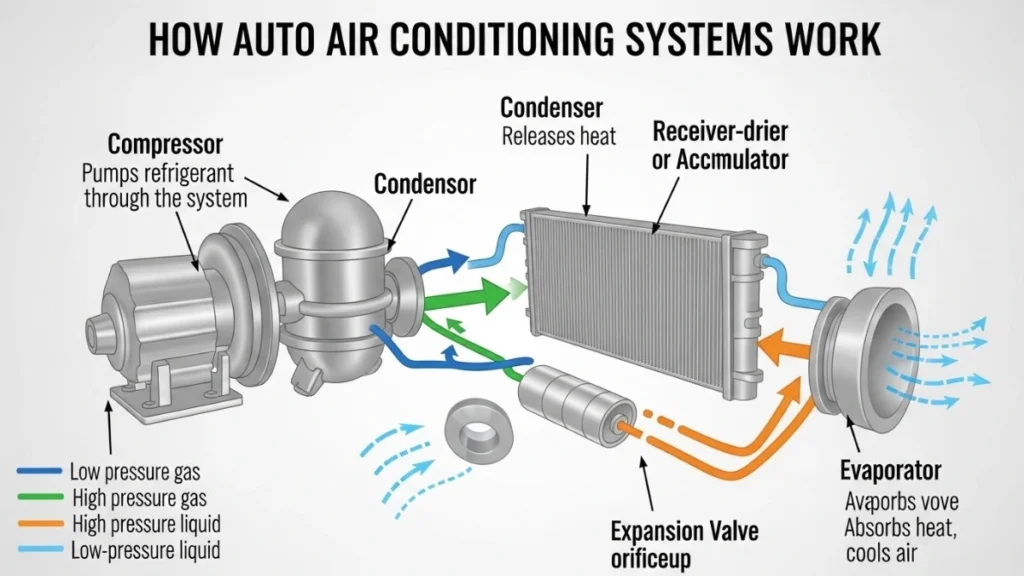
Your car’s AC system isn’t just a fan blowing cold air. It’s a pressurized, closed-loop system designed to move heat out of your cabin. Before you can repair it properly, you need a basic understanding of what’s happening under the hood.
The Main Components of A Car AC System
From my experience in the shop, most drivers don’t realize how interconnected AC components are. The compressor pressurizes refrigerant. The condenser releases heat. The evaporator absorbs cabin heat. An expansion valve controls refrigerant flow.
If one part fails, the entire system performance drops. A weak compressor can mimic a refrigerant leak. A clogged condenser can make pressures spike. That’s why guessing rarely works.
What this really means for drivers is simple: accurate diagnosis matters more than replacing parts quickly. AC systems operate under high pressure. One misstep can contaminate the system or damage new components.
Why Car AC Systems Fail Over Time
Heat and vibration are relentless. Over years of driving, rubber seals dry out. O-rings shrink. Tiny refrigerant leaks develop. These leaks often go unnoticed until cooling performance drops significantly.
Compressors wear internally. Electrical connectors corrode. Condensers get blocked by road debris. Even minor front-end damage can affect AC efficiency.
In many cases, I’ve seen vehicles come in for a simple “recharge,” only to discover a slow leak that had been ignored for months. Refrigerant doesn’t just disappear. If levels are low, there’s usually a reason.
Understanding that helps you avoid short-term fixes that don’t last.
Step-by-Step: How To Repair Auto Air Conditioning

When someone asks me how to repair auto air conditioning, I start with process, not parts. There’s a logical sequence that prevents wasted time and money. Let’s break it down.
Step 1 – Diagnose The Exact Problem
Every proper AC repair begins with system pressure testing. I connect manifold gauges to check high and low side pressures. These readings tell a story.
Low pressure on both sides often signals low refrigerant. High pressure can mean a blocked condenser or overcharge. Uneven readings may point to compressor failure.
I also inspect for visible oil residue around fittings. Refrigerant carries oil. Where oil leaks, refrigerant usually escapes too.
Skipping this step leads to misdiagnosis. Accurate testing saves you from replacing parts that aren’t broken.
Step 2 – Check Refrigerant Levels
Low refrigerant is one of the most common causes of weak cooling. However, topping it off without fixing the leak rarely solves the problem long term.
From my hands-on experience, I use recovery equipment to measure exact refrigerant quantity. Overcharging can damage the compressor. Undercharging reduces cooling efficiency.
Many DIY kits promise quick fixes. Some work temporarily. Others introduce sealants that clog professional equipment later.
If your AC gradually lost performance over months, there’s likely a small leak. Identifying it first protects your system and your wallet.
Step 3 – Inspect The AC Compressor
The compressor is the heart of the system. When it fails, cooling stops entirely.
Common signs include loud grinding noises, clicking sounds, or the clutch failing to engage. I often see compressors damaged because they ran low on refrigerant for too long.
Internal compressor failure can send metal debris through the system. When that happens, repairs become more extensive. Flushing lines and replacing additional components may be necessary.
Catching compressor problems early reduces overall repair costs significantly.
Step 4 – Examine Electrical Components
Not all AC problems are mechanical. Electrical faults are surprisingly common.
Blown fuses, faulty relays, and damaged wiring can prevent the compressor from activating. Climate control modules can also fail.
I test voltage at the compressor clutch and verify signal input from the control panel. Without electrical confirmation, mechanical replacement doesn’t make sense.
Modern vehicles rely heavily on electronic controls. Proper diagnostics require scan tools and wiring diagrams, not guesswork.
Step 5 – Repair Or Replace Faulty Parts
Once the issue is confirmed, targeted repair begins. This may involve replacing a leaking hose, faulty condenser, or worn compressor.
I strongly recommend quality components backed by warranty. Cheap aftermarket parts often fail prematurely. That leads to repeat labor costs.
Reputable shops provide written estimates and explain why replacement is necessary. Transparent communication is one of the strongest trust factors I evaluate at AHS Rankers.
Good repairs solve root causes, not surface symptoms.
Step 6 – Vacuum and Recharge The System
Before adding refrigerant, the system must be evacuated with a vacuum pump. This removes moisture and air.
Moisture inside an AC system forms acids. Those acids damage internal components over time.
After vacuuming, I recharge the system with manufacturer-specified refrigerant quantity. Accuracy matters here. Even a few ounces off can affect performance.
This is where professional equipment makes a difference. Precision prevents long-term reliability issues.
Step 7 – Performance Testing
Repair isn’t complete until testing confirms proper operation.
I measure vent temperature with a thermometer and monitor system pressures again. A proper AC system should cool quickly and maintain consistent airflow.
I also perform a short road test. Stop-and-go traffic can reveal cooling issues that don’t appear in the bay.
Performance testing ensures the repair holds under real-world conditions, not just in a controlled environment.
When To Attempt DIY Vs. Visit A Certified Mechanic
Some maintenance tasks are simple. Others carry risks. Knowing the difference protects both your vehicle and your safety.
Repairs Some Drivers Can Handle
Cabin air filter replacement is easy. A clogged filter restricts airflow and mimics weak AC performance. Checking visible fuses is also reasonable. Cleaning debris from the condenser area can improve cooling slightly.
These tasks require minimal tools and no refrigerant handling. They’re safe starting points.
If cooling improves after these checks, you may avoid a shop visit. If not, deeper diagnostics are necessary.
Repairs That Require Professional Equipment
Refrigerant recovery and recharge require specialized machines. Federal regulations restrict improper handling due to environmental impact.
Leak detection often involves UV dye or electronic sniffers. Compressor replacement requires system flushing and precise recharging.
Electrical diagnostics demand wiring diagrams and scan tools.
From my experience in the shop, DIY compressor replacements frequently lead to contamination issues. Professional service prevents secondary damage.
If the system must be opened, professional repair is usually the safer route.
How To Choose A Trusted Auto AC Repair Shop

AC repair isn’t just about technical ability. It’s about trust. At AHS Rankers, I evaluate shops based on real-world signals, not advertising claims.
Look For ASE Certification
An ASE-certified technician has passed standardized testing and demonstrated hands-on competence. That certification doesn’t guarantee perfection. It does signal training and accountability.
I always recommend verifying credentials directly. Shops that proudly display certifications tend to value professional standards.
Dealer-level training can also be beneficial, especially for newer vehicle models.
Evaluate Diagnostic Transparency
A trustworthy shop explains findings clearly. They show you pressure readings. They identify leak points. They provide written estimates. If explanations feel rushed or vague, that’s a red flag.
Clear communication builds confidence. Honest mechanics understand that informed customers make better long-term clients.
Transparency is one of the strongest ranking criteria I use.
Check Real Customer Reviews
Online reviews reveal patterns. Look for repeated mentions of honesty, clear pricing, and follow-up support. A few negative reviews are normal. Consistent complaints about misdiagnosis are not.
I study review trends carefully before ranking shops. Consistency matters more than perfect ratings. Reviews reflect real experiences, not marketing language.
Ask About Warranty Coverage
Reputable shops back repairs with written warranties. That applies to both parts and labor. If a compressor fails within the warranty period, you should not pay twice.
Warranty coverage signals confidence in workmanship. Shops unwilling to stand behind repairs often cut corners.
It’s a simple question that reveals a lot.
Notice The Overall Customer Experience
Clean waiting areas, organized bays, and respectful communication indicate professionalism. Timely updates during repairs show respect for your schedule.
As per my experience, shops that care about details often deliver consistent mechanical results as well.
Trust is built through small interactions, not flashy advertising.
What Makes Some Repair Shops Rank Higher Than Others
Ranking repair shops requires objective standards. Paid directories often prioritize advertising budgets. I prioritize verified performance.
Consistent Customer Satisfaction
Shops that rank highly maintain steady positive feedback across years, not months. Repeat customers signal reliability. Long-term reputation matters more than temporary promotions.
Consistency reflects stable leadership and strong internal standards.
Hands-On Experience With AC Systems
Experienced technicians diagnose faster and more accurately.
Shops that frequently handle car AC repair across domestic and import models develop sharper troubleshooting skills.
I value real-world depth over volume alone.
Transparent Pricing Practices
Clear labor breakdowns build trust. Fair market rates align with local averages. Unexpected add-ons erode credibility.
Transparent pricing is one of the strongest differentiators between average shops and top-ranked ones.
Proper Diagnostic Equipment
Modern AC machines measure refrigerant precisely. Advanced leak detection tools pinpoint issues quickly. Equipment investment shows commitment to accuracy.
Professional-grade tools reduce guesswork and increase repair reliability.
Final Thoughts
Auto air conditioning repair demands careful diagnosis and informed decision-making. Minor airflow issues may have simple solutions. Pressurized system failures often require professional expertise.
At AHS Rankers, I evaluate repair shops based on certifications, transparency, real customer experiences, and consistent service quality. Rankings are never influenced by paid placements.
That independent approach gives drivers clarity when comfort, safety, and long-term reliability matter most.
Add your first comment to this post